

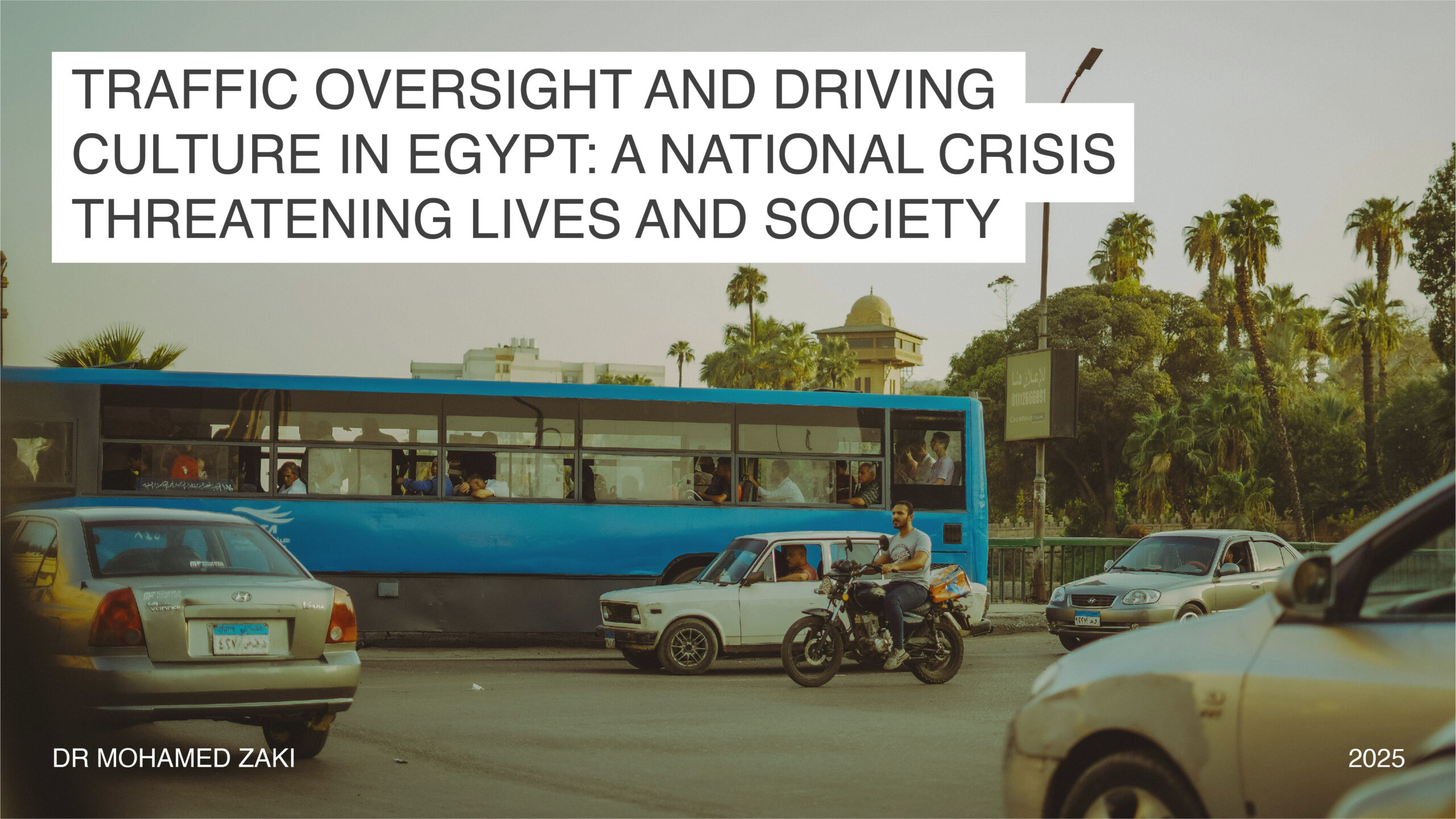
Traffic Oversight and Driving Culture in Egypt: A National Crisis Threatening Lives and Society
Despite Egypt’s recent urban and economic progress, traffic safety remains one of the country’s most pressing challenges, affecting both citizens and the state. While infrastructure is expanding and vehicle numbers are rising, the traffic system continues to struggle with effective regulation, and the culture of safe driving has not evolved at the same pace as economic growth. What is observed daily on the roads is not merely a collection of individual mistakes or isolated violations, but a recurring pattern of chaos that reflects a systemic crisis, endangering lives and imposing enormous costs on the national economy.
A clear manifestation of this issue is the absence of continuous traffic enforcement. On most streets, monitoring is sporadic at best, with the General Traffic Department often focusing on sudden campaigns in selected areas far from the most dangerous roads. These temporary campaigns create only the illusion of oversight, as traffic often returns to chaotic conditions within hours. Vehicles move freely and unpredictably, severe violations are commonplace, and adherence to lanes and speed limits has become a routine exception rather than the rule. The direct consequence of this reality is a sustained increase in accidents, ranging from minor collisions to fatal incidents, with ongoing effects on both society and the economy.
The culture of driving in Egypt presents another major challenge: limited societal awareness of traffic discipline. Many drivers routinely ignore lane rules, exceed speed limits, use mobile phones while driving, or engage in aggressive behavior on the road. These behaviors are not confined to a specific demographic; they are widespread across age groups and social classes, creating a hazardous environment for everyone, from private car drivers to public transport users and pedestrians. Children and young people are particularly vulnerable, as they are exposed daily to unsafe driving norms and may internalize risky behaviors that persist into adulthood.
The economic implications of this crisis are substantial. The cost of accidents extends far beyond direct damages such as vehicle repairs or medical expenses, encompassing long-term healthcare, lost productivity, psychological impacts on families, and even reputational consequences for communities. Each death or serious injury adds to the financial burden on the state and strains infrastructure and healthcare services. Moreover, accidents affect insurance systems and create uncertainty in sectors dependent on transport and urban infrastructure development.
The social and psychological dimensions are equally concerning. Road chaos generates constant insecurity among citizens, producing ongoing stress during daily commutes. Road rage, unpredictable overtaking, and reckless behavior exacerbate societal tension and undermine collective discipline. The lack of consistent enforcement deprives drivers of the opportunity to learn proper road behavior, reinforcing a perception that violations go unpunished, which normalizes unsafe driving and perpetuates the cycle of accidents.
Legal and regulatory challenges further compound the problem. While clear traffic laws exist, including speed limits, lane discipline, and penalties for violations, enforcement is often limited, inconsistent, or symbolic. Temporary campaigns cannot replace sustained monitoring, and drivers quickly adapt to the gaps in enforcement, assuming the roads are theirs to navigate without accountability. This behavior is more than a legal violation; it represents a direct threat to public safety and contributes significantly to the high accident rate.
Addressing this crisis requires a comprehensive and long-term strategy. First, traffic monitoring must be continuous and not limited to temporary campaigns, including greater deployment of traffic officers on main and secondary roads and the implementation of modern monitoring systems, such as speed cameras, early warning devices, and artificial intelligence to detect violations in real-time. Second, the promotion of a culture of safe driving must be systematic, starting with schools, universities, and media campaigns, and extending to ongoing driver training programs to instill discipline and raise awareness about the risks of reckless driving. Third, strict penalties must be enforced to ensure compliance with lane usage and speed limits, serving as an effective deterrent for repeat offenders.
Community awareness campaigns are also essential to change behavior and strengthen individual responsibility toward public safety. Drivers must understand that driving is not merely a means to reach a destination; it is a responsibility toward human lives, society, and national economy. Promoting this awareness reduces accidents, saves lives, and creates a safer traffic environment while lowering the economic and social costs of road incidents.
Ultimately, the lack of traffic oversight and weak driving culture in Egypt represents a multifaceted crisis that goes beyond legal infractions. It is a social, economic, and psychological problem that threatens citizens’ lives, increases national expenditures, and challenges the community daily. Addressing this issue requires genuine political will, comprehensive strategies, modern technological tools, continuous awareness campaigns, and strict law enforcement to ensure a safe traffic environment, reduce accidents, protect lives, and balance urban growth with safe mobility for all citizens.